- Vital Shift
- Posts
- Sweat Equity: Minute 10 is a Liar
Sweat Equity: Minute 10 is a Liar
Issue #21 · Nov 2025 Recap · Read Time: 5.5 minutes

Tahsin Khan
December 07, 2025
This is my monthly audit, done in public: the deposits I made, the friction I hit, the signals that mattered, and what the month bought me.
💰 Opening Balance
A single moment where I paid the price or collected the reward for showing up.
It was minute 10 of a speed run about 6 weeks ago, and it felt awful. A feeling I don’t get every time, but shows up uninvited more often than I’d like.
I wasn’t sore. Not tired. It just felt wrong. Like someone swapped my legs for someone else's heavier pair and forgot to tell my lungs. My body seemed had lost the memo about being trained for this.
The 'wise' voice arrives on schedule, dressed in concern: Be smart. Don't be reckless. Listen to your body. Maybe I didn't recover enough from yesterday’s workout.
I slow down. Just a touch. Enough to feel relief without admitting defeat. But slowing down cracks something else open. If one in three or four workouts feels like this, and I dial it back every time, that's 1/3 of my training evaporating into sophisticated excuses. A slow negotiation into mediocrity every time my body forgets its own resume.
I pick the pace back up to target. My legs protest reflexively. My lungs burn. Both obey, for the time being.
Twenty minutes. Still ugly.
Thirty minutes. Still grinding.
When I finished the session—the workout executed as written—I was embarrassed at how close I was to giving up 20% into the workout, compared to what I was capable of in reality.
I text my trainer afterward. Half confession, half field report.
He responds immediately: “Yup. 1/10 workouts feel like progress. 7-8/10 feel like punching the clock. 1-2/10 feel like you're moving backwards. The most important workouts are those bottom 1-2, not the top 1-2.”
The majority of workouts don’t feel this bad, but enough of them do. These sessions aren't offering permission to back off. They're testing whether you mean what you say about discipline.
Progress isn't the ones that feel good. It's the ones where every step negotiates with surrender, and you refuse the terms.
Next time the voice returns, I'll have evidence it's lying.
I open my training log and write one line: “Minute 10 is a liar.”
📊 Micro Frictions, Macro Lessons
A breakdown of what changed, or what I wrestled with this month. Not all shifts are groundbreaking.
🔬Something I Tried
Any health tracking device I use has to pass three hurdles:
Is it frictionless? Does it fit seamlessly into my life, or do I have to manage it?
Is it actionable? Does the data actually inform behaviour change? Data without actionable insight is useless trivia.
Is it additive? Does it tell me something I don't already know?
This month, I decided to try out the Oura Ring to get a deeper understanding of my sleep patterns. I was curious to see if it would offer more detailed insights compared to my Garmin watch.
⇥ The Verdict: For me, the Oura failed all 3.
Frictionless? I felt it every time I typed, lifted, or grabbed anything.
Actionable? It delivered prettier graphs than my Garmin’s, but didn’t change any decisions.
Additive? No new insights. Just a difference interface on data I already had.
If you’re curious, the 30-day trial is worth using to run your own experiment. I sent mine back after two weeks.
⇥ Next: I'm re-testing the WHOOP 5.0 through the same three hurdles.
🌚 The Darkness Tax
My motivation is solar-powered. The sun is gone by 4:30 PM; my brain interprets "dark" as "done." By 6 PM it's cold, dark, sometimes snowing, and the gym might as well be three zip codes away.
⇥ The Adjustment: Once the light goes, the feeling of wanting to train disappears. So I treat sunset as a soft deadline. I still win most days, but after dark, the friction shows up with a better lawyer. If I can tilt the odds by lifting before the sun clocks out, I do.
💳 Outstanding Debts
The battle(s) I haven't won yet. The habits that refuse to stick and the biological bills I keep rolling over to the next month.
🔴 The Struggle: Most people want the number on the scale to go down. I need it to go up, ideally 1-2 lb/month.
↳ I’ve been in a muscle-building block all year, which requires a sustained caloric surplus (with adequate protein of course). No extra concrete, no skyscraper.
🟡 The Cost: For the last five months, my weight has flatlined. I was training hard, but under-eating for the goal.
↳ With my metabolism and schedule, that extra 200–300 calories feels like a second job every day.
🟢 The Status: I didn't change the strategy; I gave it a higher priority.
↳ I treated food volume with the same non-negotiable intensity I apply to training—tracking the input and refusing to under-eat just because I was busy. I’m up 1.5 lbs this month. It sounds small, but after five months of stagnation, it’s significant progress.
📜 The Paper Trail
Anyone can write. Fewer people show the ledger. So here's my training, what it costs, and why I'm willing to pay for it.
I ran a 3-day split between lifting and running for 14 months.
It served its purpose early on, but training maturity changes the math. What drives progress at early stages eventually stops pulling its weight.
In the last 4-6 months, my strength gains have become marginal—a byproduct of trying to optimize two demanding systems simultaneously.
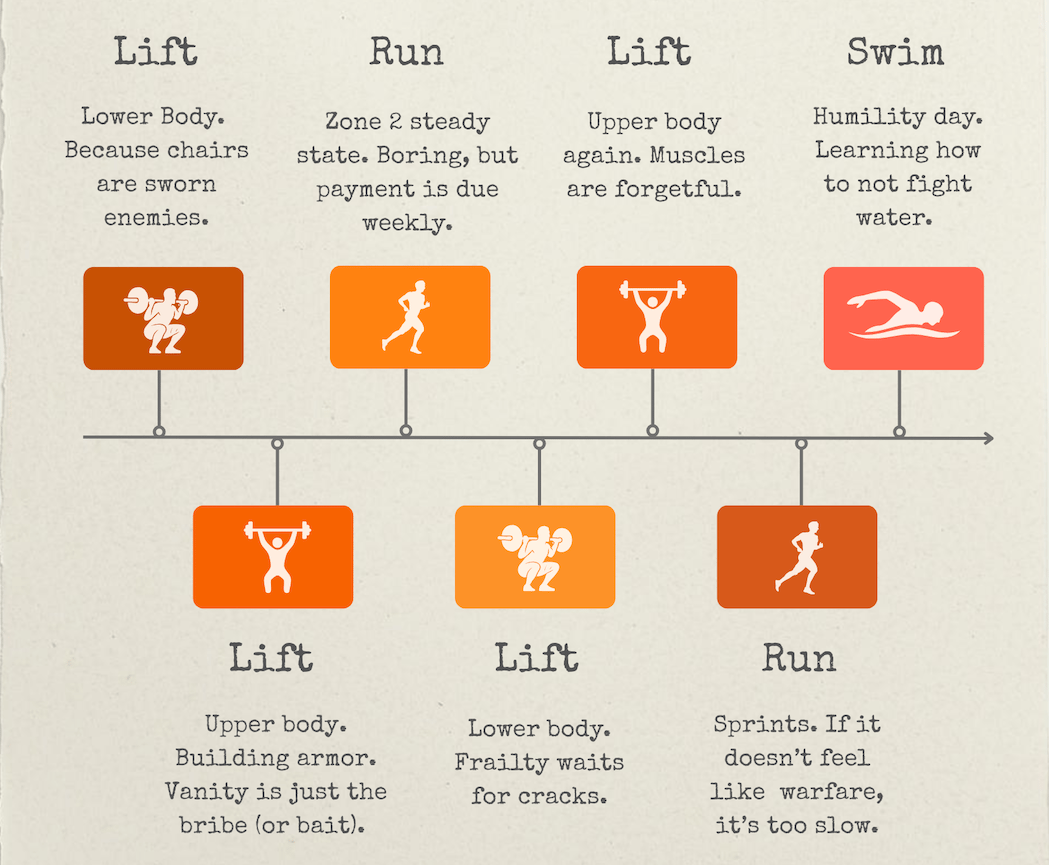
For this winter block (until April), I’m tilting the scale to a 4:2 split that favours weightlifting because muscle mass, power, and strength are non-negotiable for healthspan.
Lifting (3 → 4 Days): [2 days upper body / 2 days lower body] split compared to my previous full-body workout per session.
This allows me to squeeze in significantly more volume of work per muscle group than before.
Running (3 → 2 Days): Running drops to maintenance mode.
Swimming (1 Day): This remains a skill practice, not a fitness driver.
It is my lowest priority, so if life demands it, this is the first asset I will liquidate.
📝 The Receipts
Sweat always leaves a paper trail. Sessions logged. Misses visible. The receipts show the work, not perfection.
My knee injury from October didn’t bounce back as fast as I wanted, so I cut running volume from ~100 km to 40 km. I had to get creative to keep the engine humming along without straining my knee. The solution was humble, boring, and painful.
The Ego Check: High-incline treadmill walks (10-12% grade). Heart rate up, legs burning, time moving slowly.
The "Dry Land" Drowning: I replaced sprints with a low-impact conditioning loop. 4 Rounds of: 5 min Air Bike → 5 min Row → 5 min Ski Erg → 5 min Rest. I gave up a minute early on round 3, and my future self is not proud of it.
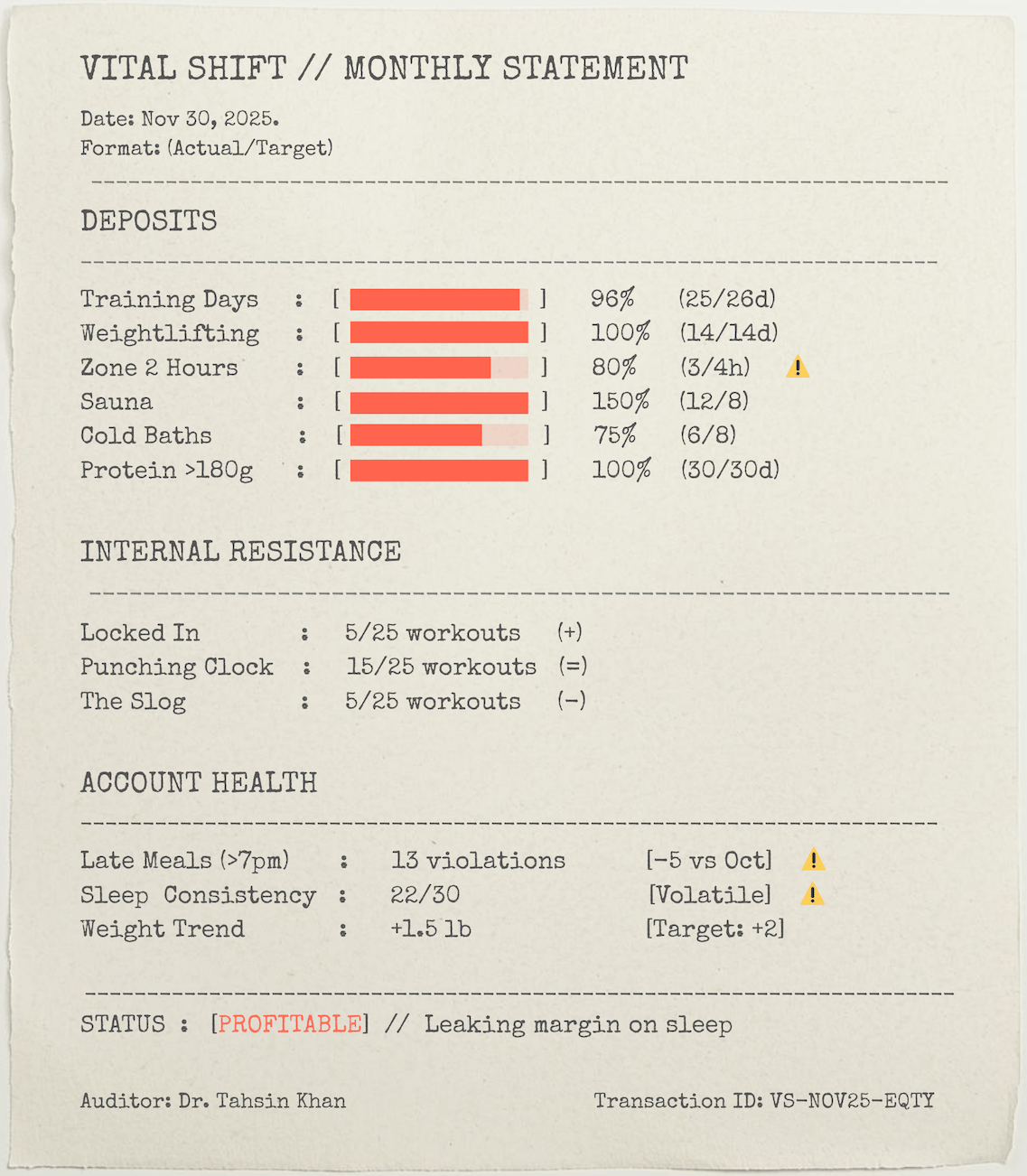
This month was an improvement over October in terms of consistency and quality of effort. I also started tracking internal resistance — a score of how much my brain protested within the first 10 minutes of each session. It just resurfaced the truth I keep running into: most workouts feel like punching the clock, but they get done anyway.
🔍 Follow my Strava to see all my recorded workouts and track my progress. It's all there for accountability.
💹 This Month’s Return
I managed to gain 1.5 pounds after five months of stagnation. The knee behaved. The running form is coming back, and the new workout split for December is starting to show its fingerprints.
The numbers matter because they are the proof that something moved. What matters more is what had to happen to move them at all — choosing to meet the friction when the voice in your head files for tactical retreat.
That moment is the hairline crack between soft mediocrity and the ugly climb toward the self I promised I would be. Slow, steady surrender is a living death I won’t entertain.
The quantifiable return this month seems small. The direction isn’t.
The ledger always grows on one side or the other, and this month, it shifted in the right direction.
🎒The Gym Bag
The swag that helps me sweat.
👟 Lifting Shoes: Reebok Nano
🏃🏽♂️➡️ Running Shoes: Adidas Evo SL, Saucony Endorphin Speed 3, Asics Superblast
⌚ Fitness Tracker(s): Garmin Forerunner 955, WHOOP 5.0 Peak
🩳 Running Shorts: Bandit, Tracksmith, Patagonia
🎽 Training Tops: Vuori, Ten Thousand
I'm a Toronto doctor caring for older adults in hospitals and nursing homes, while spending my spare time digging into longevity science. I'm here to share what I'm learning. No fancy jargon, just practical insights to help you read your body’s early signals. Think of me as your friendly guide, figuring this out alongside you. Medicine has changed, but how we practice it hasn't caught up. That's why I'm here: to help you edit your health story while the early drafts are still open.
Reply