- Vital Shift
- Posts
- Sweat Equity: Stopping Leaves a Residue
Sweat Equity: Stopping Leaves a Residue
Issue #23 · Dec 2025 Recap · Read Time: 5.5 minutes

Tahsin Khan
January 18, 2026
This is my monthly audit, done in public: the deposits I made, the friction I hit, the signals that mattered, and what the month bought me.
💰 Opening Balance
A single moment where I paid the price or collected the reward for showing up.
This year’s recap is an exorcism to confront a stubborn ghost—the unwanted version of me that moved in when COVID hit and I let my training rust for two years.
Between 2018-2020, I was in medical residency. Most mornings started before sunrise in a no-frills gym that reeked of sweat and iron.
Alarm at 5:30AM.
Plates clinked in cold air.
Every workout session became a religious ceremony, tracked and measured with the same diligence I used for medical orders on the ward: dates, weights, reps—all tallied and treated like vows sworn to steel. Chalk in my palms and ink in my notes. Then scrubs, antiseptic corridors, pager buzzing.

I lived in two residencies: weightlifting at dawn, then medicine devouring the rest of the day and night.
I was stronger than I’d ever been. The bar’s rough steel chewed my palms. Thick calluses etched into my hands as proof of work.
I packed on more than 20 pounds of muscle over that period. My training log climbed like a staircase—quarter after quarter of new personal records that I still haven’t topped to this day.
Then March 2020 arrived…
I was months from my licensing exams, and poised to start a pain medicine fellowship I had spent two years orchestrating with care. Overnight, a tangle of politics pushed the regulatory bodies to redraw the lines on who qualified, and the gate to that path closed, putting me in limbo.
Days later, the world snapped, and I splintered with it.
The COVID shutdown indefinitely postponed my licensing exams and chained the gym doors. I was confined to a bedroom, stripped of the gym and the next step in my career, uncertain if path I’d so carefully built existed in this new reality.
With that buzz in my skull, I tried turning my bedroom into a gym: bands biting a doorframe screw, two dumbbells thudding on a thin rug that slid under my feet. No plates to load, no weight that talked back.
Everything, including my effort, felt counterfeit.
I trained to build and progress, not mimic movement. While the rest of my life idled on blocks, these half-measures grated on me.
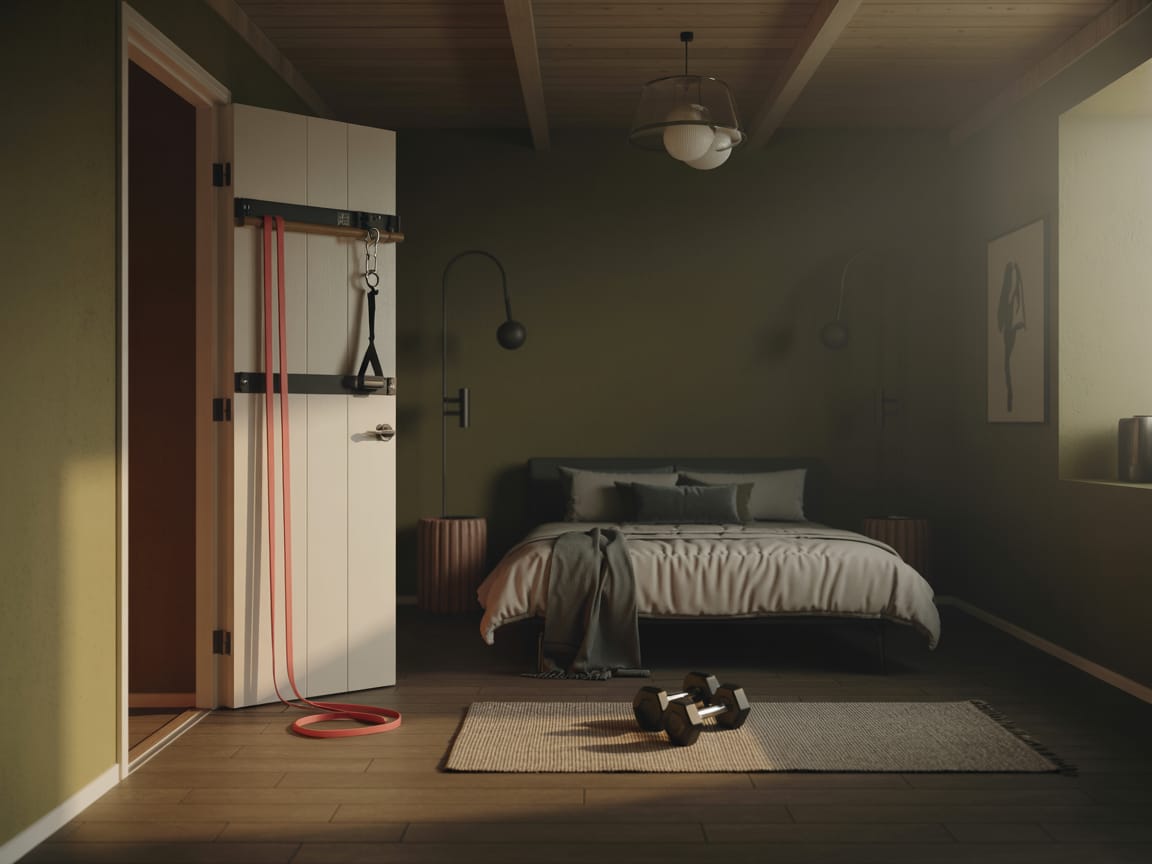
After a few months, my bandwidth snapped. I sold the dumbbells and resistance bands, and banished the logbook to a shelf where it collected dust for the next 2 years.
During those years, I moved through each week with my stomach in a fist—stress edging into near‑panic—as I stared at a fogged‑out calendar, unsure if my job would still be there next month. Everything ran month‑to‑month: temporary contracts, shifts confirmed then cancelled, schedules rewritten last-minute.
Sleep thinned. Meals became whatever I could grab with one hand. The training log stayed closed, and my protein intake and macros went neglected.
By the end of those two years, 25 pounds had stripped off my frame. Years of sweat dried into dust. When I shook hands with the iron again in mid-2022, there was no “jumping back into it”. I crawled…
The steel felt foreign in my hands; wrists quivered; breath stalled between reps.
The bar wobbled on the way down.
Smaller numbers inked in the logbook landed like insults.
It was a year of swallowing humiliation while teaching a reluctant body to say ‘yes’ again; each session measuring the ache between present day and what I used to be.
That gap became a scar I trained around. 2023 and 2024 were a long, unglamorous march where I stopped chasing the old ghosts and started stacking small wins.
Humiliation calcified into discipline.
Then December 2025 tried to pry the seams apart: workload and stress up significantly, nights cut short, phone lit like a warning flare. The “logical” voice showed up with its usual sales pitch: You’re too tired to train effectively. Just pause. Wait until January when you can give 100%.
I’ve shared a room with that ghost. And I’m not inviting it back.
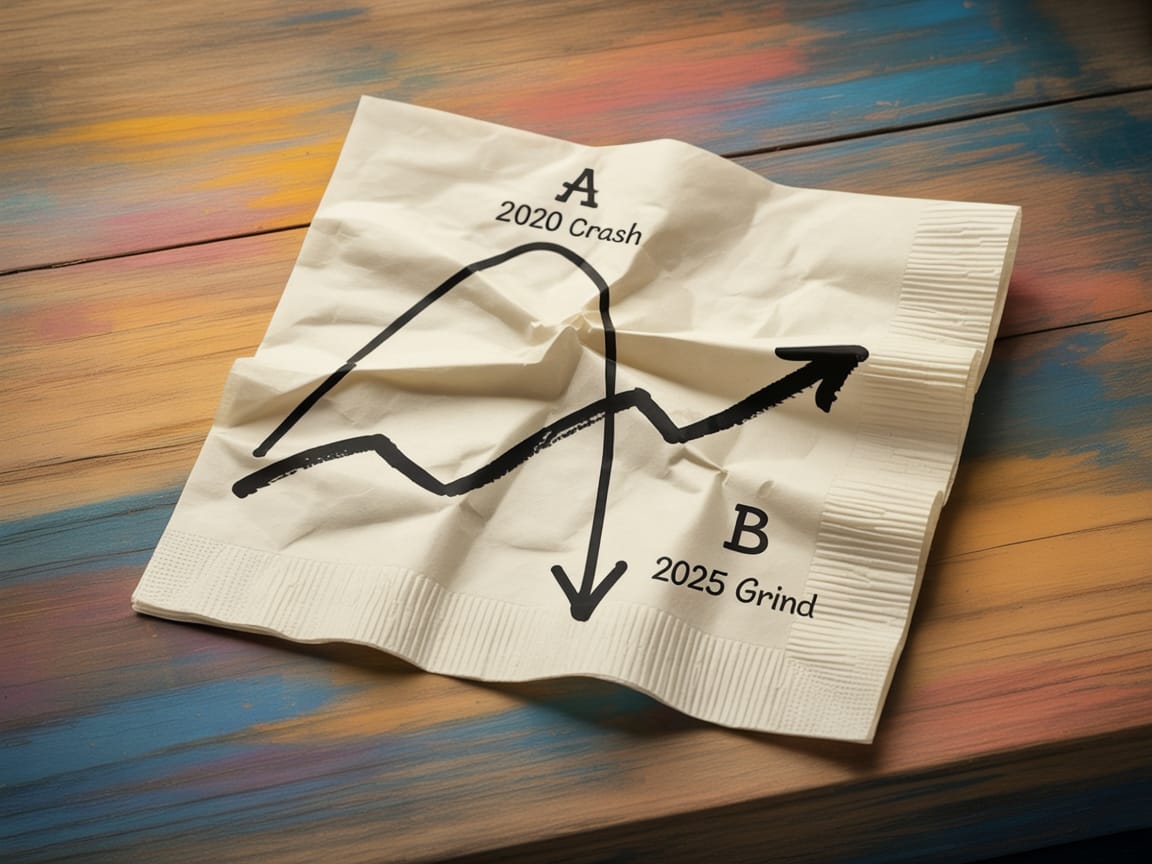
I remind myself one rule: move forward by any measure, because anything above zero compounds.
All committments in life draw from the same battery. When the rest of life turns hostile, there’s less juice left for training. If I can train hard for more than 70% of the year, that’s an excellent year. The other 30%—months like the last one—are for easing off, recalibrating, and getting ready for the next surge.
When life yanks hard, change gears, not the vow.
So, I didn’t pause. For two weeks, I stripped back some of the heroics from my program. I showed up tired and did the minimum effective dose. My sessions shifted from mountains to curbs I could step over.
This isn’t a license to drift into permanent mediocrity. Recalibrating is a deliberate, time‑bound tool when life gets heavy—to keep the progress line from reverting to zero.
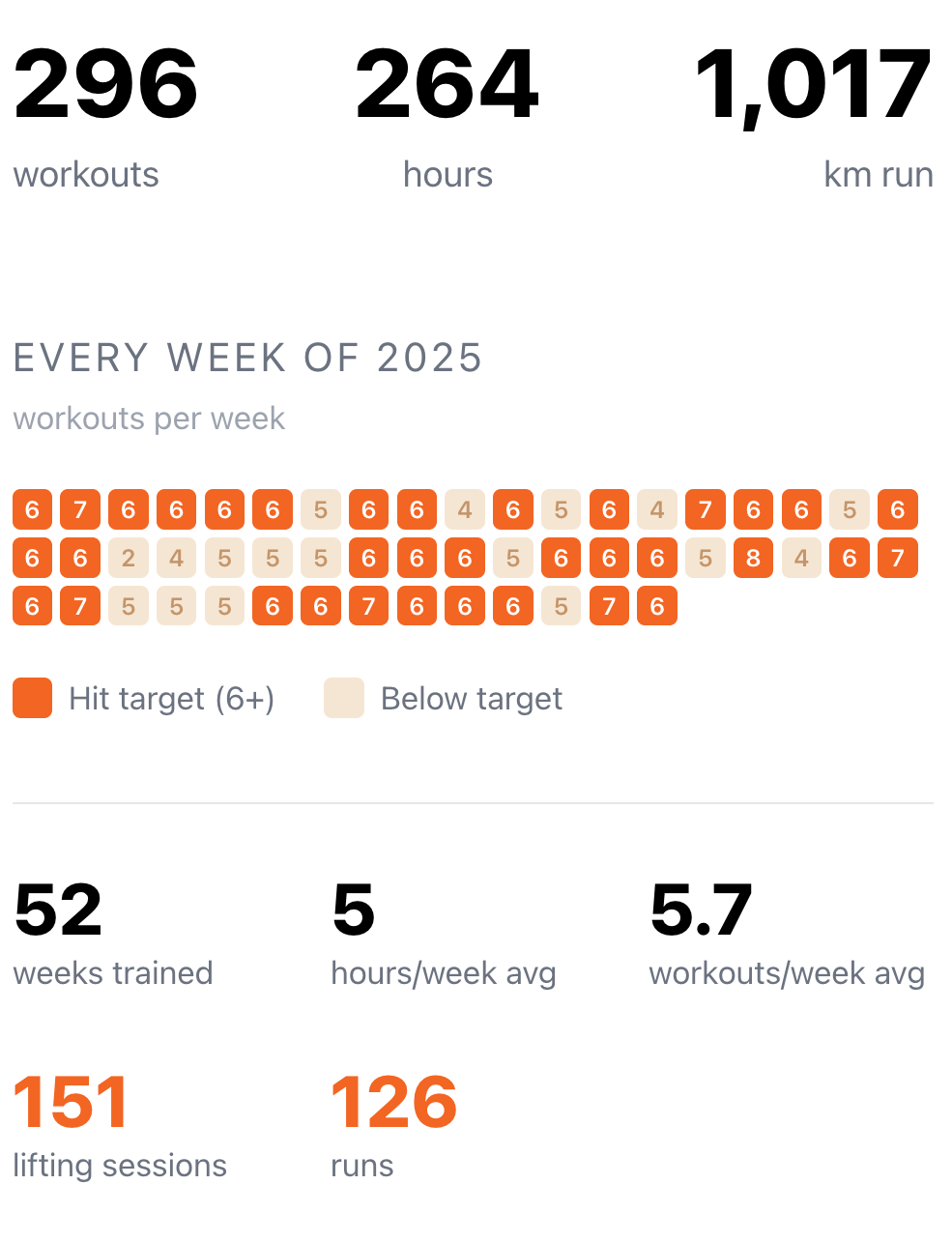
The result isn’t a string of fireworks. It’s a scuffed tally of showing up; another coin on the counter to keep that unwelcome ghost on the other side of the door. Zoomed out, those coins stacked to 296 training sessions in 2025.
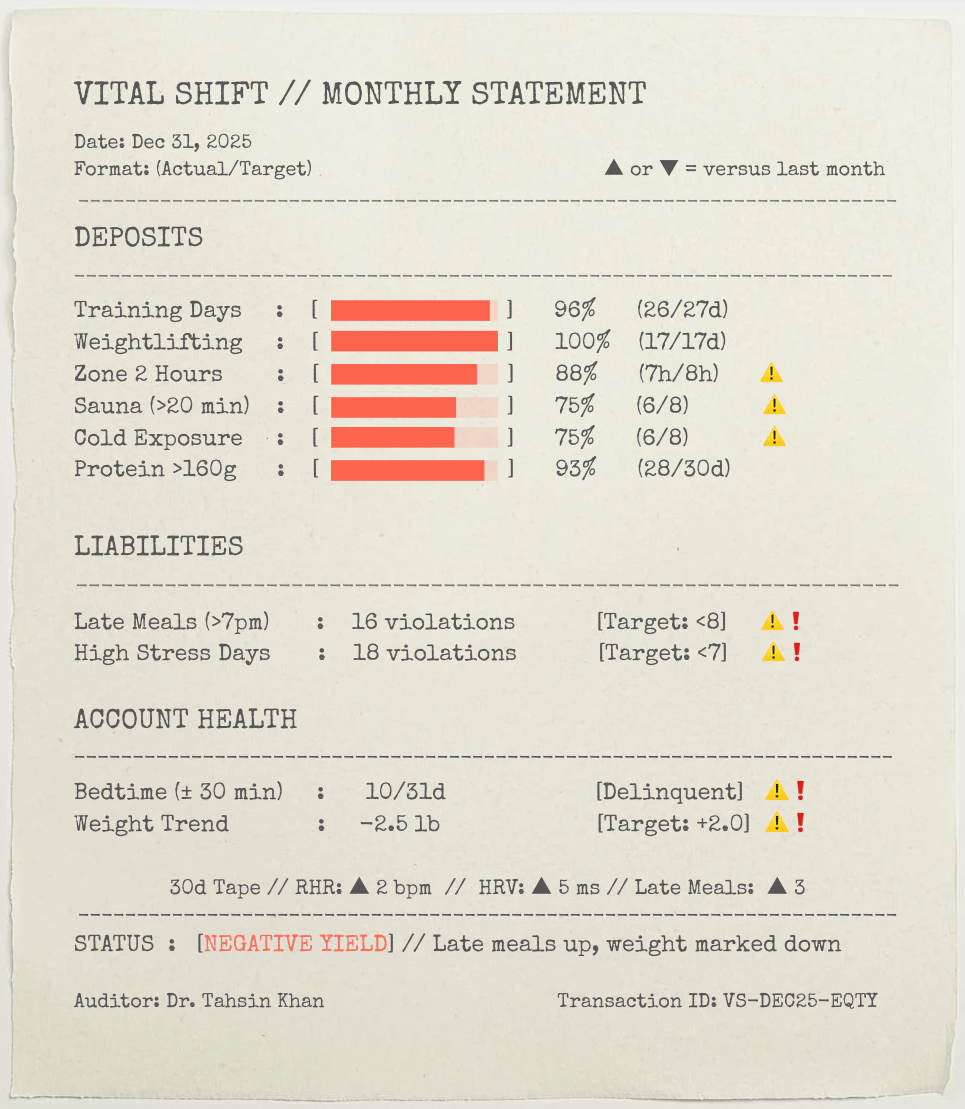
The ledger below tells the story.
📝 The Receipts
Sweat always leaves a paper trail. Sessions logged. Misses visible. The receipts show the work, not perfection.
Windmilling dumbbells or clocking the same slow treadmill stroll ≠ progress.
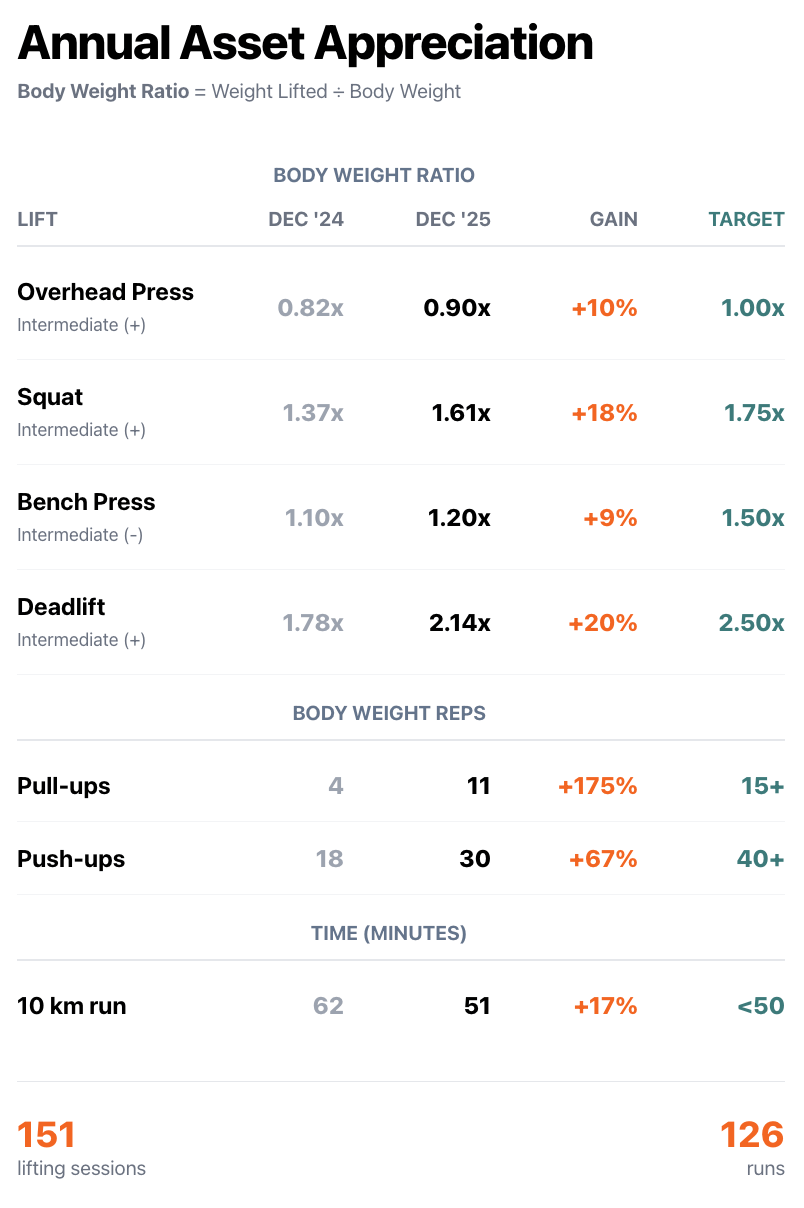
The table below exists to answer two questions:
Did the work compound or did I conflate motion for progress?
Did I train hard and consistently enough for the necessary adaptations to take place?
⇥ How strength is measured
Strength is shown as load relative to body weight, not absolute weight. This normalization allows for accurate comparison of usable strength across different body types and over time. For example: A 100-lb (45 kg) person deadlifting 250-lb (113 kg) carries more relative strength than a 175-lb (80kg) person lifting the same amount.
→ The story behind each target
These targets sit roughly in the top 10% for my age and sex—high enough for me to feel confident in meaningful risk reduction in falls, mortality, and metabolic health, but not so high that they require elite specialization or shove aside other priorities.
→ What the table fails to capture
Strength shows up as the benchmark because it is the most easily testable pillar of longevity. The table reflects what made it through the sieve of measurement, not the whole of what mattered.
Muscle power matters.
Muscle mass matters.
Aerobic capacity matters.
They’re all being trained, but harder to express in a neat table.
💳 Outstanding Debts
The battle(s) I haven't won yet. The habits that refuse to stick and the biological bills I keep rolling over to the next month.
🥣 Debt #1: Late-Night Eating
🔴 Struggle: Creative ‘work’ often lulls me into multi-hour "flow states" where I’m so locked in that meals become an afterthought. By the time I come up for air, I end up consuming 60% of my daily required calories around 9 PM. This habit has hounded me for a year.
🟡 Cost: Eating this close to sleep is metabolic vandalism, thanks to two culprits.
Digestion raises core body temperature; deep sleep doesn’t settle until the temperature drops. For most people, that mismatch is the chief sleep-wrecker.
When melatonin surges after dark, insulin’s responsiveness drops, giving that late-night meal a front-row ticket to visceral fat storage.
🟢 Status: A major win would be the elimination of this ongoing debt within the next three months.
🥣 Debt #2: Weight Drift (Wrong Direction)
🔴 Struggle: High stress forces me me to neglect meal prioritization during intense work periods. I simply forgot to eat due to the workload, resulting in unintended calorie deficit and weight loss.
🟡 Cost: I fought for every pound of lean mass. Losing any because I’m “too busy to eat” is a steep price. Muscle is hard to build and easy to lose; a shin-kick I give myself.
🟢 Status: Negative balance, skirting delinquency.
🔍 Follow my Strava to see all my recorded workouts and audit my progress.
💹 This Month’s Return
This year didn’t banish old ghosts. It proved I can keep them on the porch.
December shows up as a negative yield month inside a positive year.
The numbers lurched. Some habits slipped. A few debts still gnaw at the ledger. Yet, the net balance compounded in the right direction.
The gains in the charts didn’t come from “staying active.” They came from deliberate training, applied to the right levers, pulled in sequence, with enough consistency to force adaptation.
This year wasn’t a stack of workouts. It was a trail of choices that were audited by reality.
That’s what I trust. A loop: train, measure, tweak. Every few months, the plan adjusts based on signals, not the weather in my head.
The ledger communicates that record more clearly than I ever could.
As I step into a planned 8-week break from clinical work, the goal extends beyond recovery theater. It’s a partial reset. Fewer overnight call demands. More room to train, eat, and think with intention while I work through a handful of business endeavours that will bring their own headwinds.
The year ends with higher capacity and fewer vulnerabilities than it began with, bought and paid for with sweat equity.
🎒The Gym Bag
The swag that helps me sweat.
👟 Lifting Shoes: Reebok Nano
🏃🏽♂️➡️ Running Shoes: Adidas Evo SL, Saucony Endorphin Speed 3, Asics Superblast
⌚ Fitness Tracker(s): Garmin Forerunner 955, WHOOP 5.0 Peak
🩳 Running Shorts: Bandit, Tracksmith, Patagonia
🎽 Training Tops: Vuori, Ten Thousand
I'm a Toronto doctor caring for older adults in hospitals and nursing homes, while spending my spare time digging into longevity science. I'm here to share what I'm learning. No fancy jargon, just practical insights to help you read your body’s early signals. Think of me as your friendly guide, figuring this out alongside you. Medicine has changed, but how we practice it hasn't caught up. That's why I'm here: to help you edit your health story while the early drafts are still open.
Reply